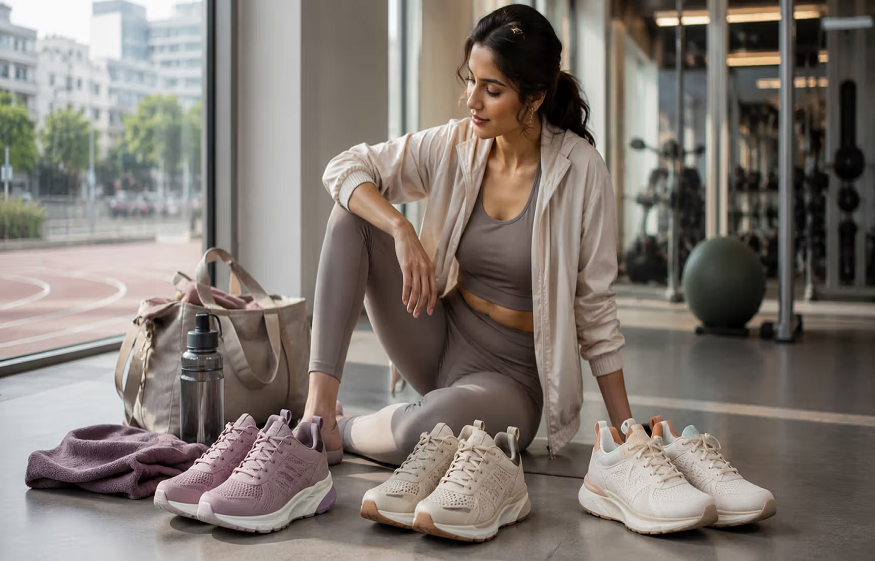

Sports shoes and gym bags affect every session regardless of workout type. Getting both right produces a noticeably better training experience across the week.
Women Sports Shoes: The Foundation of Every Session
Women sports shoes are the single most important piece of fitness equipment for any workout that involves standing, moving, or lifting. The shoe determines how force travels through the foot and into the ground during each movement, which affects everything from performance to joint health over time.
Cross-training women sports shoes have a flatter, more stable sole that handles lateral movement, jumping, and resistance training. Running shoes are cushioned for forward motion and create instability during lateral exercises.
| Workout Type | Shoe Feature | Why It Matters |
| Running | Cushioned midsole, heel-to-toe drop | Impact absorption |
| HIIT and cross-training | Flat, stable sole | Lateral movement support |
| Weight training | Minimal heel rise, firm sole | Ground force transfer |
| Yoga and Pilates | Grip sole or barefoot style | Floor contact and stability |
Women Gym Bags: Organisation as a Training Tool
Women gym bags affect training consistency in a way that is easy to underestimate. A bag that holds everything needed for a session without requiring a reorganisation every time removes a friction point that, small as it sounds, contributes to skipped sessions over time.
The most functional women gym bags have a wet or shoe compartment that separates used kit from clean clothing, a secure zip compartment for valuables, and enough volume to hold a water bottle, change of clothes, and any training accessories without overpacking. A structured base keeps the bag upright when set down at the locker or on the gym floor.
Pairing Both
Sports shoes and a gym bag that are ready to go at the same time remove the logistical thinking from getting to a training session. Many regular gym-goers keep their bag packed between sessions, which makes the decision to train one fewer step in the day.
Read More: SPORTS PHYSICALS: A PRE-PARTICIPATION EXAMINATION (PPE)
To Wrap Up
Women sports shoes and women gym bags on AJIO cover training footwear and kit organisation across 1,000+ options. Returns are accepted within 30 days of delivery.
FAQs
1. Running shoes or cross-trainers for a general gym session?
Cross-trainers for most gym sessions that include a mix of cardio equipment, resistance training, and floor work. Running shoes are optimised for forward motion and the cushioning creates instability during lateral exercises and lifting.
2. How often should women sports shoes be replaced?
Every 500 to 700 kilometres for running shoes, or every eight to twelve months for regular gym training shoes. The midsole cushioning compresses before the upper shows visible wear, so the shoe can look fine while no longer providing adequate support.
3. What size gym bag works for a standard gym session?
Most single session requirements: shoes, a change of clothes, towel, water bottle and small personal items fit between 25 and 40 litres. More suitable for travel or sessions with big equipment needs > 40 litres
4. Does the bag material matter for gym use?
Yes. Nylon and polyester are the most practical choice for gym bags because they are resistant to moisture, easy to wipe clean and hold their shape through repeated use. Fabric bags will absorb moisture and odour over time, which synthetics don’t.
Read More: THE BEST BODYBUILDING PROGRAM
5. Should sports shoes be stored in the gym bag between sessions?
In the shoe compartment, yes. Storing them in an enclosed bag immediately after a session without airing them first accelerates odour build-up. The better approach is to air the shoes for an hour or two before placing them in the shoe compartment for the next session.